How I helped a global energy company grow capability and shift from technical product fixes to driving behavioural shifts
posted 4th November 2024
CHALLENGE
The business wanted to streamline global well design and planning. A standardised process was in place, but the digital tools built to support it weren’t being used consistently, particularly by regional teams.
MY ROLE
As a Senior Service Designer, I helped reset how teams understood user problems and co-designed solutions for maximum adoption and user value.
IMPACT
The product team moved from tech fixes to user outcomes and built capability into product team’s ways of working for scalable and sustainable change.
My approach was human-led and focused on building capability, not just delivering new digital services
What I did
I led a strategic discovery to understand users, their pain points and uncover opportunities.
To get stakeholders aligned around critical user problems, begin ideating and co-designing solutions I led a 4-day design sprint, followed with weekly team learning (latterly changed to fortnightly) to embed feedback loops and grow innovation capability. This fostered a human-centred approach and ensured changes were scalable and sustainable.
Step 1: Understand different user groups, their journeys and pain points
I led qualitative research with regional and global teams. I mapped decision-making journeys, pin-pointed areas of friction and surfaced unspoken blockers to adoption and change.
Reframing the problem
What originally looked like a tooling problem was really a cultural problem, rooted in mindset, trust and embedded behaviours.
Regional and global teams had different values and pain points. Regional teams liked to maintain their own way of working. Global teams wanted centralised standards, including central global tools, to make picking up work easier and faster.
I shared these insights with the product team and senior stakeholders across regional and global teams in facilitated sessions, hearing each other, often for the first time. That changed the tone and moved from blame to shared understanding.
Regional teams:
- Saw global tools as irrelevant to their work or optimising workflows.
- Wanted to protect their expertise - they believed centralised products diluted deep expertise.
- Clung to local spreadsheets rather than adopt global tools.
Global teams:
- Felt lost in handovers. They could not rely on the central global tools for the data they needed.
- Lacked context and were unsure of data credibility so data and calculations were often reworked.
Step 2: 4-day design sprint to raise collective awareness, reframe problems & co-design solutions

Day 1: User problems – help teams understand users and their actual pain points
I facilitated structured coaching sessions to help teams to understand divergent users and surface root causes of pain points.
This shifted the conversation:
- From “they won’t use it” → to “they don’t trust it”
- From “we need training” → to “we need clarity and psychological safety”
Day 2: Opportunity framing – focus on user impact and desired outcomes
I introduced "How Might We" statements focused on user-specific outcomes, not business KPIs.
Examples:
- HMW make it easier to capture and label data clearly for regional engineers so they save time and feel in control of their work?
- HMW make it easier to reuse shared data for global engineers so they can contribute faster and avoid delays?
This reframing reset priorities, away from generic adoption goals toward solutions with clear user value.
Day 3: Ideation – Generate Practical Solutions Rooted in Real User Behaviour
I coached teams through structured ideation sessions designed to move from insight to action.
We started with a Digital Safari to review internal and external tools. This helped teams identify what already worked elsewhere—and what could be adapted.
Then we used Crazy 8s and Crazy 6s to push divergent thinking. Teams generated quick, rough ideas—focused not just on features, but on behaviours they wanted to shift.
Next, we mapped new user journeys—layering in opportunities for behaviour change, peer support, and trust-building.
Throughout, I challenged teams to anchor their ideas in:
- Real tasks users were trying to do
- Specific pain points from earlier research
- The desired behavioural outcomes
This was targeted ideation grounded in users’ day-to-day realities.
Day 4: Co-design Nudges and Prepare to Test in the Real World
We moved from ideas to testable concepts, ocusing on nudges that support adoption, trust, and shared understanding.
Digital Nudges:
- Source transparency tags (showing author, update date, data origin) to reduce ambiguity
- Contextual prompts explaining why a field or input was needed, not just what it was
- Visible attribution to specific contributors, encouraging pride and accountability
Non-Digital Nudges:
- Lightweight handover cheat sheets to support clearer onboarding
- Peer-led induction sessions to create shared norms around data use
- “No stupid questions” spaces to reduce fear of asking for clarification
I guided teams to:
- Prioritise quick-win ideas that could be piloted fast
- Define behavioural success criteria for each concept
- Identify what data or feedback would validate impact
My job was to coach, challenge assumptions and keep the focus on user impact. By the end of Day 4, teams weren’t just pitching ideas, they were ready to test them in context with users.
Step 3: Embed feedback loops and build test-and-learn habits
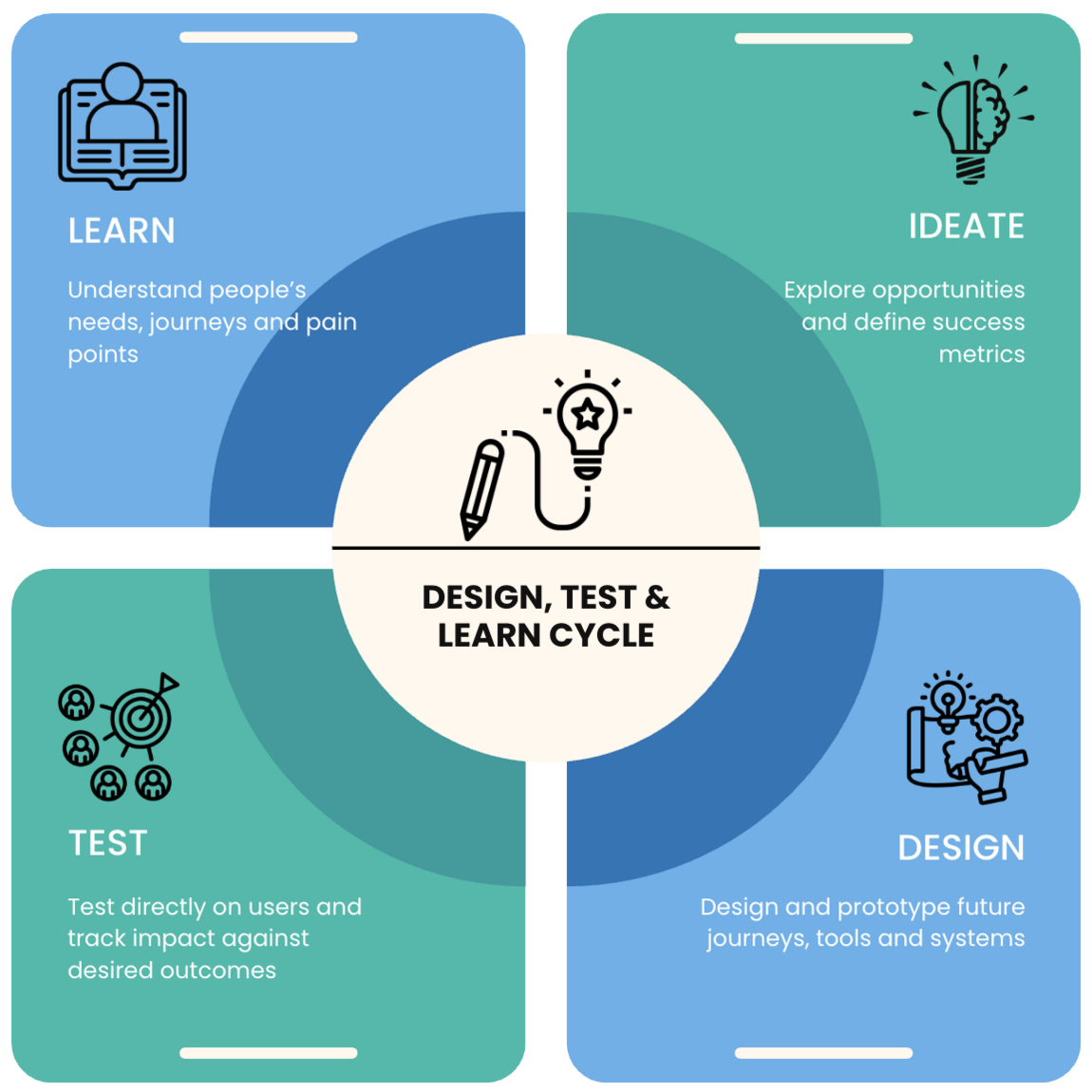
After the sprint, I supported ongoing learning, iterative design and prioritisation over 6 months, which was based on the above framework: learn | idea | design (prototype) | test.
- Feedback loops tied to real tasks
- Weekly reviews to track progress and learn
- Uncover new insights to inform the next iteration of design
- Clear North Star metrics and behavioural KPIs
This supported rapid iterations and embedded learning as a repeatable habit.
Measurable outcomes & why it worked
- Tool usage and advocacy increased by ~20 points
- Teams reported less rework and higher trust in shared data
- Engineers felt more confident navigating handovers
- A shared language for behaviour and value replaced friction
I didn’t just run a process, I coached a shift in thinking and helped teams:
- Move from tech fixes to user outcomes
- Understand behaviour as the design challenge
- Build design capability into their daily ways of working
- Align around impact, not just compliance
The tools did need to be improved, but the real issue was a breakdown in trust and aligning teams around common goals. By reframing challenges around behaviour and coaching people through change, we unlocked value for both users and the business.