
How I helped a global energy company uncover automation and AI opportunities by understanding the people behind the data
posted 6th January 2025
The Challenge
Integrity & Reliability engineering teams are responsible for maintaining well integrity and safety over the long-term. To do this effectively, they need accurate details of well components.
The data was often inconsistent, difficult to find or missing. These made it harder to proactively maintain the well or diagnose production issues as they happened.
The impact was significant: deferred production, missed cross-regional learnings and costly late-stage fixes which could be traced back to weak data capture during earlier well design and completion phases.
What I did
I led a strategic discovery over 6 months, using a systems-led collaborative approach, across the end-to-end journey from well design through to production and long-term safety and maintenance. My aim was to understand:
- How engineers made design decisions and the data they needed to inform decisions
- How engineers maintained the ongoing safety and integrity of wells
- How data flowed from suppliers and within and across teams
- Identify opportunities for standardisation, automation and responsible AI.
Outputs & Impact
I identified data suitable for automation, activities suitable for AI and designed a human-in-the-loop service model. This ensured engineers remained in control.
Anecdotally, users reported faster access to reliable data, more confidence in decisions and reduced time spent on manual tasks. While commercial savings remain confidential, the discovery identified and quantified a solid roadmap to better-performing wells and a more scalable, sustainable service rooted in reliable data.
Approach in more detail
Discovery approach
I combined deep qualitative research with collaborative systems mapping to understand the real-world challenges engineers faced. I spoke with engineers across every stage of the well lifecycle, from design, drilling, and completions (focused on well delivery) to production and long-term maintenance to surface their journeys, needs and pain points.
I didn’t just explore what data was used, but also how decisions were made, what teams needed to feel confident about their decisions and what stood in their way. I mapped how data was captured, used, stored, shared and reused across engineering teams. This revealed hidden interdependencies and gave me a systemic view of how work and information flowed end-to-end. From there I was able to reframe key problems and co-explore opportunities with users and stakeholders.
Along the way, I ran Show & Tells and hands-on workshops to make the work visible, tackle tough problems together and keep everyone aligned.
The engineering teams impacted
Design, Drilling & Completions teams:
- Focus on delivering safe reliable wells for production
- Develop detailed wells designs and specifications, drill and complete wells and finally produce final well handover documentation
- Rely on data from suppliers and previous well designs that worked well
Production teams:
- Focus on maximising productivity of wells
- Manage effective and efficient production of active wells
- Rely on well handover documentation including well designs and equipment schematics
Integrity & Reliability teams:
- Focus on long-term well reliability and safety
- Monitor well performance and maintain reliability over the well life span
- Rely on well handover documentation including well schematics and any updates to well configuration during life span
“Pulling together handover docs (in Word and Excel) is so manual and time-consuming. There must be an easier way to do this in this day and age?”
“It's not easy to access up-to-date well data. Final designs are stored in one data base. Maintenance updates are stored somewhere else. We don't always know if we're looking at the most up-to-date data and this waste time!”
“Data quality varies from team to team and across regions. Sometimes we cannot find what we need. It can take days to clean data before we can diagnose on issue on an individual well. And we can only deal with one well at a time!”
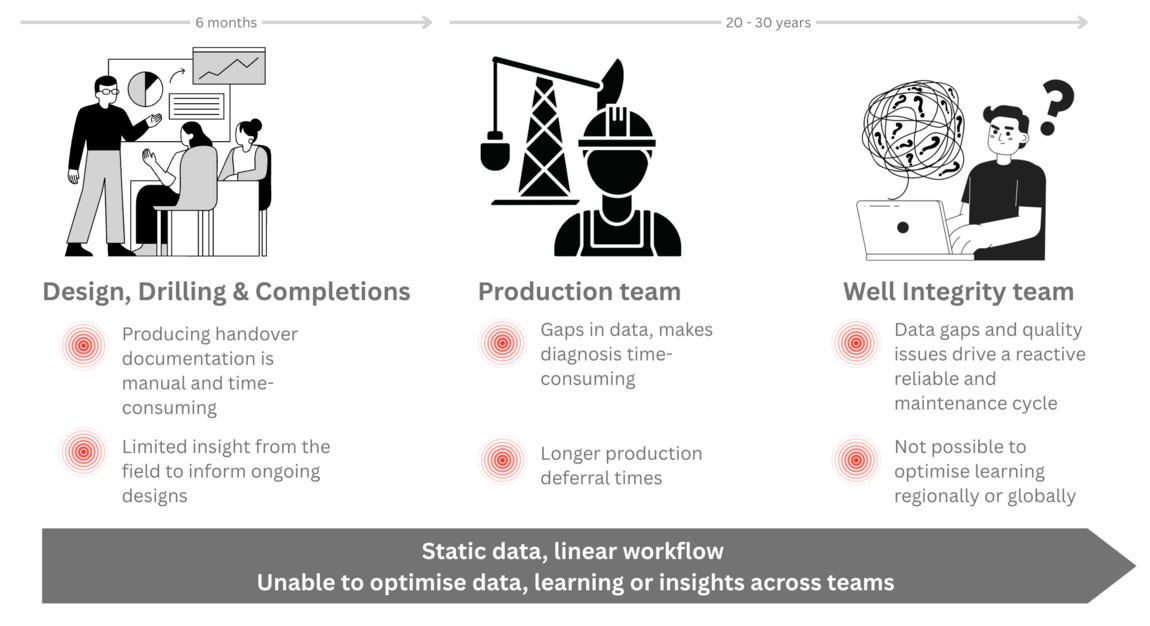
Data flow across teams
Each engineering team needed to access and reuse data across the workflow and over the long-term.
Design, Drilling & Completions teams:
- Wanted to produce reliable handover documents quickly and easily so they could get back to developing the next well
- But collating well data and documenting was manual and time-consuming and the team had limited oversight on what other downstream engineers (Reliability & Integrity) really needed
- Resulted in a human-led time-consuming process which was often inconsistent and prone to error
Production teams:
- Needed easy access to well details so they could get the well up and running and quickly deal with any production issues later in the life-cycle
- But often struggled to access the level of details they needed to make speedy diagnosis for intervention
- Resulted in time-consuming diagnosis and longer deferred production times
Integrity & Reliability teams:
- Needed access to granular details to understand well components and configurations to inform maintenance plans
- But this was difficult, especially for older wells, as there were often gaps in data or the data was not up-to-date
- Resulted in wasting time looking for data, reworking analysis before making decisions. It was not possible to pin-point wells with similar patterns, so plans and improvements could not be scaled across regions
Additionally, feedback from production and integrity teams back into well design was weak so new learning and insights did not informing well design best practice.
Reframing the problem
At first glance, this looked like a maintenance issue. “We cannot diagnose issues with well performance because we don’t have a reliable picture of the equipment in our wells, especially older wells. For younger wells there's some chance the team is still working here so we can ask them directly.”
In reality, it was a systems problem.
- Teams goals and priorities were disconnected. Data problems didn't start downstream (well integrity), they originated in early-stage design, where data capture from suppliers was patchy and inconsistent.
- Information was static, often saved in unstructured Word or PDF files, so it was difficult to search and re-use in a meaningful way.
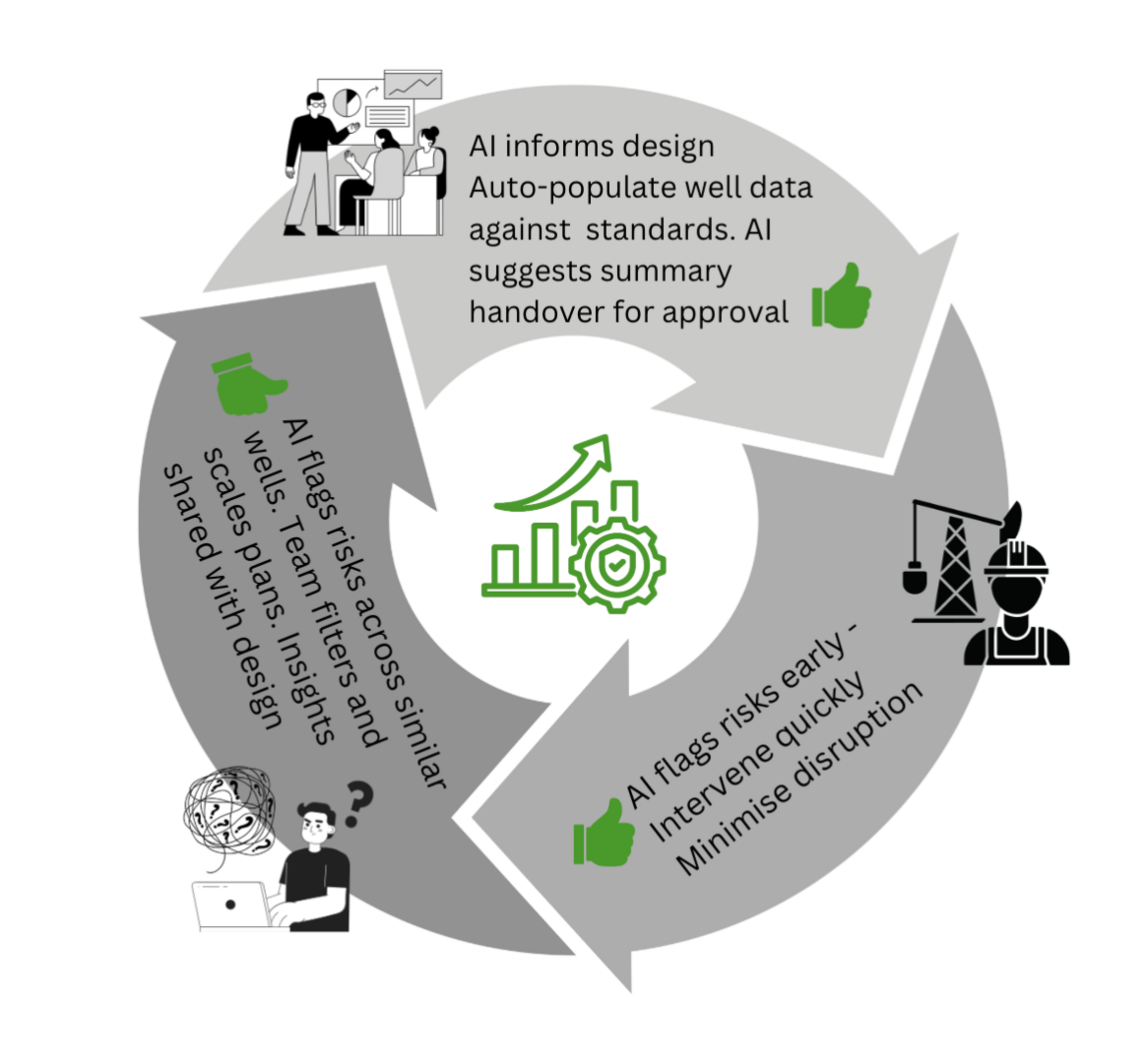
- Data workflows and hand-offs for new wells were linear. While there were processes to handover a new well to production, there was little formal process for feedback from production or integrity back into design. This limited the insight earlier drilling teams had to work with.
I reframed the challenge from a localised maintenance headache to a systemic cross-regional and team data capture issue affecting long-term performance, scalability and ongoing optimisation:
- Handover documents were not just an information repository, but rather a working document that would accessed and re-sued over the longer term
- Static documents have limited value, while standardised structured data can be dynamic and actionable
- Linear workflows, working one well at a time, means insights cannot be shared or optimised for new designs or ongoing maintenance
Exploring future opportunities - where automation and AI could add value
Uncovering opportunities for automation required a rethink on how data was formatted, captured and stored and shift from static information repositories to a dynamic data framework (underpinned by data standards, data models and governance).
Automation made sense for:
- Auto-populating Well IDs and supplier details during early and detailed design phases
- Auto-generating well and regional reports - standard data such as reservoir details, well equipment, supplier details
- Integrating tools to reduce duplication and re-keying of same data into multiple tools and/or locations
Result: Less manual effort, fewer errors and more time for higher-value thinking.
AI added value when:
- Summarising key insights from long reports
- Recommending similar wells for comparison and optimising maintenance plans
- Spotting risks in new designs using historical well failure data
Designed a human-in-the-loop model or agentic workflows within a workflow to support responsible AI use:
- AI suggests → engineer reviews → engineers make final decisions
- Transparency built in: engineers can see and adjust how AI recommendations are made
Result: Less manual effort, fewer errors and more time for higher-value thinking.
Breakdown of AI services that could optimise performance across design, production and ongoing well integrity
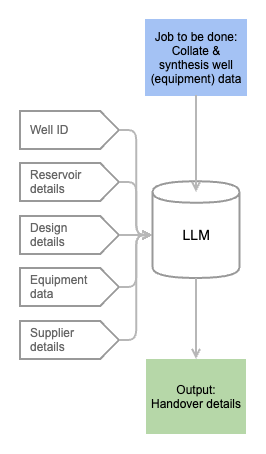
Well design handover pack to improve well production maintenance
Engineers will be able to produce reliable handover documents efficiently and give Production and Integrity teams the data they need for ongoing production and reliability optimisation.
Task breakdown:
- Review early and detailed design documents to determine critical activities
- Define consistent data sets and decisions for each stage-gate, including equipment details at detailed design and updates for actual drilling
- AI suggests a summary handover document with design rationale at each stage and prioritised next steps
- The Design Engineers review document, can edit and gives final approval
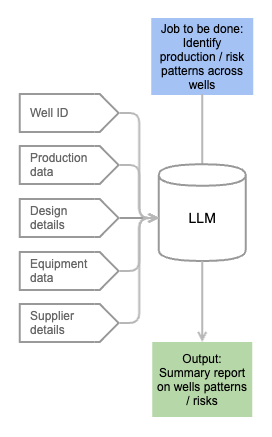
Well performance maintenance to optimise learning
Integrity Engineers will be able to diagnose issues quickly and reliability and apply these learnings across wells regionally and globally for proactive maintenance plans.
Task breakdown:
- Production signals a production issue and works with Integrity team to diagnose issues
- Integrity team searches for similar well / data histories
- AI suggests patterns and flags risks
- Well Integrity Engineers filter by context and plan proactive maintenance
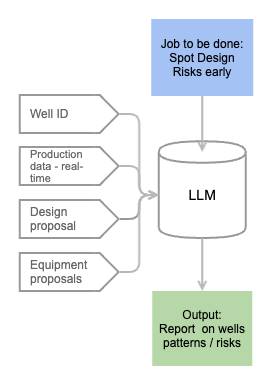
Design Sense-Check to spot risks early
Engineers responsible for well design will be able to infuse well designs with real-time learnings from the production fields, to save time and deliver safe more reliable designs.
Task breakdown:
- Upload draft design
- AI highlights known risks
- Engineers responsible for design accept, edit or reject recommendations
- All options logged for review
What this could look like for Integrity teams
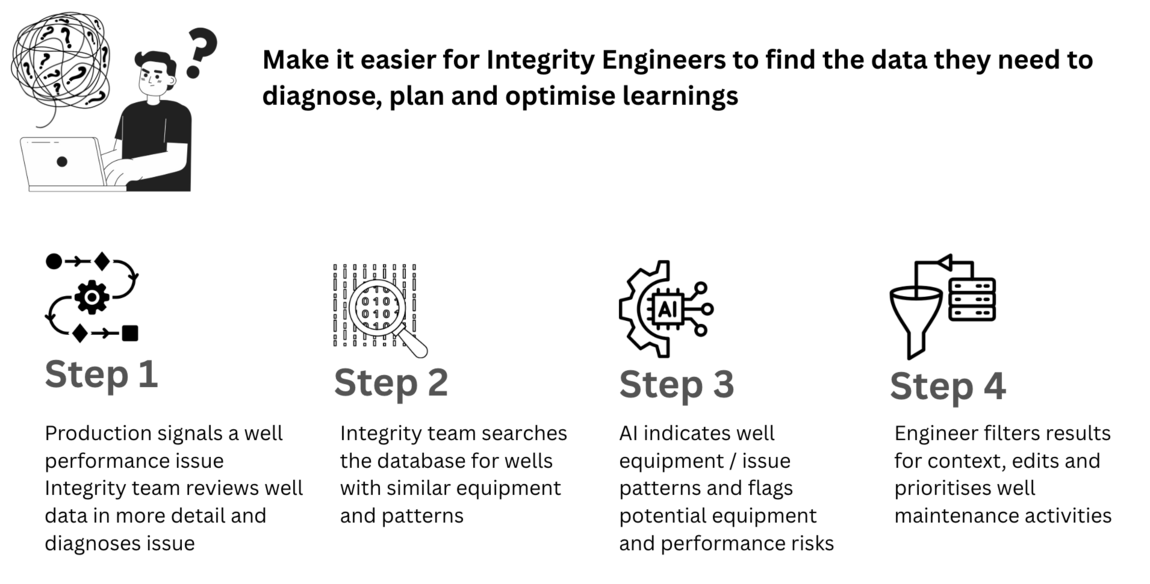
From a static linear workflow to a more dynamic integrated model
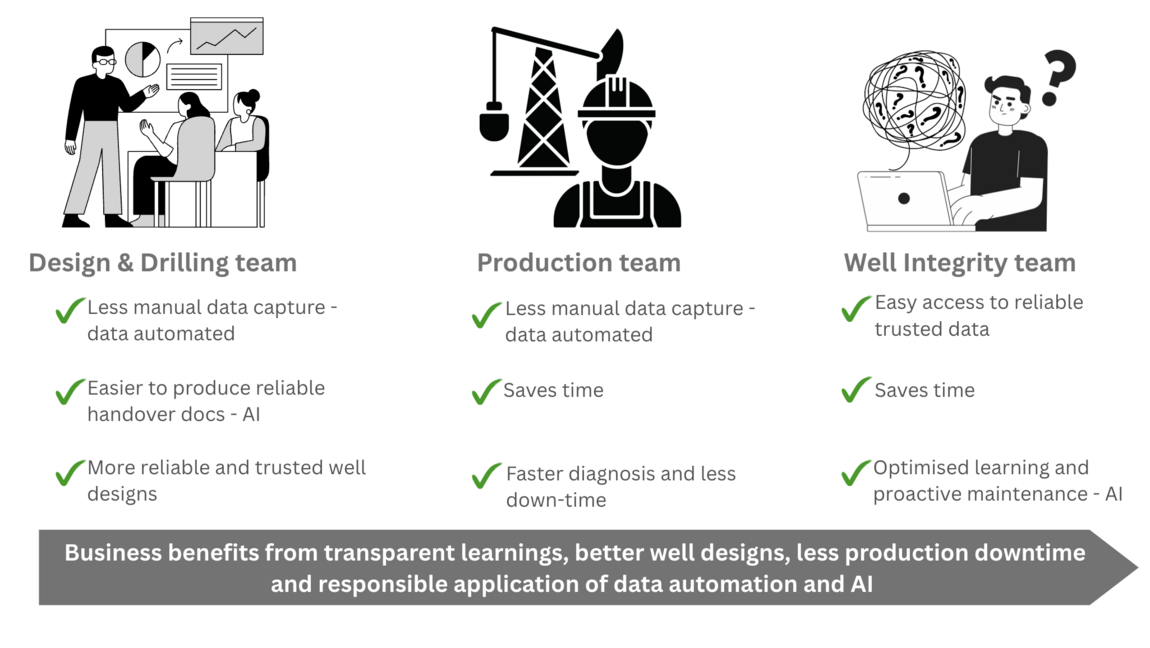
Expected benefits for users and the business overall
What I learnt
- Start with the humans behind the data, empathy is essential
- Engineers value transparency and control over “smart” features
- By understanding who needed what data and why, we could define standards and develop a pathway to creating something more dynamic
- Moving from a linear and static workflow to more dynamic model makes automation and AI solutions feasible
- AI is not a one size fits all, but it can benefit complex, ambiguous, dynamic tasks
- Buy-in and capability-building is what makes services scalable, you cannot rely on technology alone